(Wherein the Wren journeys into the Clasp)
by Sam W. Pisciotta
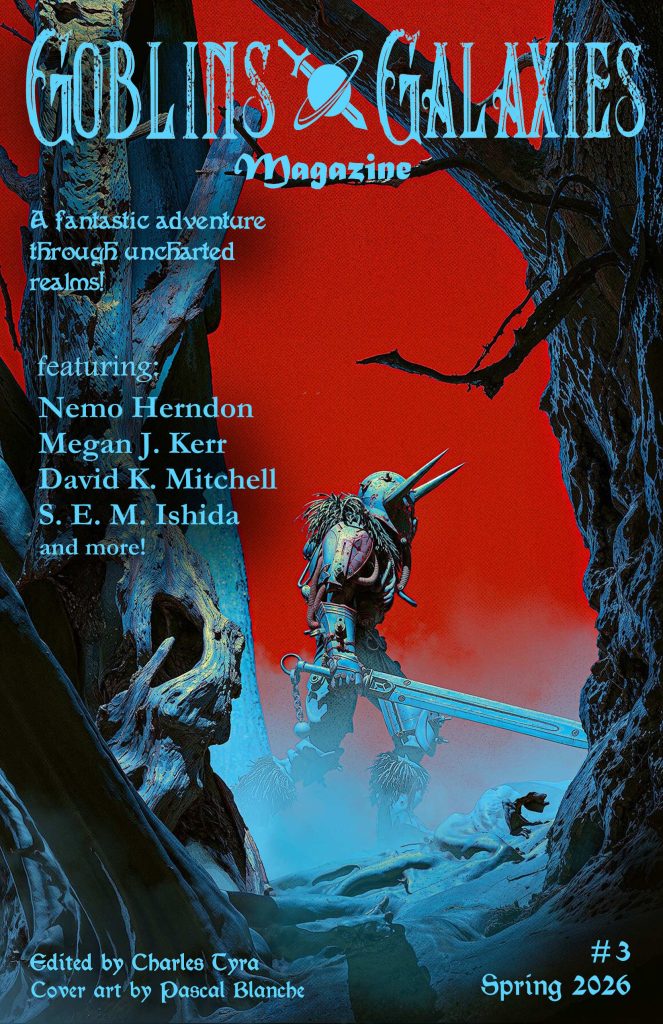
From Goblins & Galaxies #3 Spring 2026
The ship’s bell had just closed the second dog watch when the boatswain piped all hands on deck. With the sun nearly doused by the sea, the crew assembled below the quarterdeck. They mulled about with a nervous bearing. Mr. Larson, my first mate, stepped to my side.
“I can smell the fear on them,” I said.
“They’re scared, Captain. But their mettle runs deep. We can count on them.”
“You’re an optimist, Mr. Larson. Superstitious sailors, especially those heading into becalmed waters, can be more dangerous than any leviathan.”
I couldn’t help but wonder how each might hold up against the trials ahead. Men don’t fear the sea for what she shows them, but rather for what she hides.
After the men silenced, I addressed them. “Tonight, we will cross the equator. Countless sailors have made the crossing before you.” I hoped to calm them with tradition and normality. “I have crossed several times, myself, and many of you have made the crossing with me. We will do it again.”
“Under a full moon, Captain.” This came from the Boatswain, usually a sensible man. Sensible enough not to interrupt his captain. But I afforded him some leeway as I knew he spoke for the crew.
“Yes, Mr. Jorgenson. We will cross beneath a full moon. The better to see by, I should think.”
Reilly, the carpenter, turned toward a rigger and blurted what the others were undoubtedly thinking. “And through the Clasp.”
Mr. Larson snapped out, “That’s enough, Mr. Reilly.”
The carpenter, brought to heel, averted his eyes. I had a disciplined crew, but they were afraid. Storms had forced us into a more easterly course, and the Wren would sail through a notorious patch of sea running along the equator. Mariner’s lore had nicknamed these waters the Clasp.
“Pardon me, Captain.” The Boatswain nudged forward. “Might it not be more prudent to heave to and cross in the morning?”
“No, Mr. Jorgenson. It would not be more prudent. Our load of coffee awaits, and the weather has already placed us behind schedule.” We were bound for Brazil to pick up the coffee and other goods meant for Morrison and Sons in Charlotte. A timely delivery meant a lucrative bonus, and as long as I remained captain, no children’s story would jeopardize that payment.
“Perhaps we could cross nearer Brazil and away from ….”
“Enough!”
Jorgenson stumbled back into line. With a quick step along the rail, I scanned the crew, looking into their worried eyes. “We are under contract to pick up and deliver. And we will do precisely that.”
This is a truth I’ve uncovered: The monster beneath the surface lies within ourselves. Only a veneer of morality keeps us from the dark and prevents us from tumbling into chaos. Most of these men had a thin veneer indeed, and the educated and high-minded were charged to keep them close to the light.
“It’s come to my attention,” I said, “that some of you wish to draw lots. Short straws to decide a skeleton crew, men who will sail the Wren through the Clasp while the rest of us cower below decks.” I scanned the men to see which would own the cowardice.
All eyes slid down. No takers.
“I have a better idea. All of us will be on duty during the second watch. Between midnight and four, we will face the Clasp together.”
At this, a grumbling rose among them. Their eyes darted toward the approaching line and they muttered of devils and monsters.
“The sea will take three,” said Jorgenson breaking in above the chatter. He parroted superstition and lore, and all quieted at his pronouncement.
I leaned in, knuckles white on the rail. “Check your words, Boatswain.”
“I knew the cook on the Annabel,” he said as if that settled his point.
The general mood verged on panic, like the air before a lightning strike. We had all heard the Annabel’s tale, a schooner out of Dover found drifting in the lanes after her passage through the Clasp.
The Boatswain’s words were punctuated with a jarring thump, a smack on the ship’s deck. A bolt of feathers and flesh plunged from the sky to land between us in a pile of wings and feet and bird bits. A giant albatross had fallen from the sky to die on our ship. We all stood in shocked silence, our minds grasping for meaning. The men backed away, pushing and shoving one another. Their grumbling and dark predictions grew louder.
It’s in man’s nature to place meaning on chance occurrences, to find patterns within chaos. An omen of good fortune had died at our feet—an astounding coincidence. The men jostled one another, hands above their heads; wild eyes searched the sky as if more birds might fall at any moment. Their assertions mimicked one another: turn around, we’re tempting fate, home is lost.
Larson and I yelled over their cries, our tongues lashing out, steering them away from the dark edges of panic. But it was the Boatswain, Mr. Jorgenson, who quieted them. He bent and picked up the dead albatross then carried it to the ship’s rail. The bird’s wings were spread wide as he moved toward the glowing horizon. The dark wings merged with the Boatswain’s silhouette so it looked like the man wore the wings himself, and I half expected him to lift into the sky and leave us. With a gentle roll, he dropped the bird overboard and walked back to the crew, now pinned down in silence.
“It was a bird,” I said, “come too close to our mast. Nothing more.”
The crew stared back in silence, their eyes drilling holes through my logic and reason.
“If something dark awaits us in the Clasp,” I said, coiling my authority around them and cinching it to squelch rebellion, “we will face it together.” Before turning aside, I paused to deliver my command. “On the eight bells of midnight, I expect each of you on deck.”
*~*~*
The moon’s light had grown wider each night as if lifting her eye’s lid to watch the Wren with morbid curiosity. We moved into the doldrums on a faint but erratic breeze. Still, with well-trimmed sails, we managed meager progress.
There is an old sailor’s tale that whistling will call the wind. That night, I stood at the quarterdeck’s rail, the ship tangled in shadow and moonlight. Below me and all around, the men raised a chorus of whistles. Their shrill notes mixed with the hull’s creaks and groans, and the cacophony lifted into the moonlight, like calls from a flock of spectral nightingales. A melancholy seized me as the lonely whistles stirred memories of my elder brother, Andrew. He had failed to respect the power of nature and paid for it with his life.
The ship’s bell beat twice. Ting-ting. One o’clock. We had slipped over midnight’s edge into the night’s darkest hours. I fought to hold my focus. If the men were too degenerate tonight, I would need to steer them back toward reason.
The bell hadn’t yet stopped reverberating when the deck beneath us trembled, and in the air, the faintest rumbling circled us. We strained to listen, and a man blurted a call, “Hooves.”
“Horses running,” said another.
Hundreds of miles from land, how could that be? Water surrounded us. The suggestion was unreasonable, superstition and fear. Since our fathers’ time, the bands of water above and below us were known as the horse latitudes. Many a ship carrying horses bound for the Americas became stalled in their wasteland. These doldrums were no less treacherous.
The water around the Wren began to roil. The surface, once calm, now churned with agitation. The first apparitions appeared in the water, horses screaming in torment, thrashing the surface to stay afloat. They whinnied and snorted, legs hammering as the dark water pulled at them. I turned and more horses appeared, herds of contorted and struggling animals. Many horses were pulled under, disappearing beneath the surface, their cries gurgling into silence.
Within these waters long ago, our forefathers perpetrated this suffering. Their supplies dwindling and their fear growing, those men sought to save themselves. Horses had been gathered and thrown overboard to protect water rations, perhaps to appease some dark sea god who might spare their lives and pull them through the doldrums.
Now here they were, come back to punish the species who would abuse and waste their fellow creatures of the Earth. Echoes of these horses, the phantoms leaped onto our deck. Their bones protruded through decaying hide, and their eye sockets yawned. Barnacles gripped their hooves and joints, while crabs joined other sea creatures to make a home inside their decaying breasts. The animals reared up in anguish, running and spinning and bucking. Hooves lashed out at the men, catching an unlucky few in a blind panic. Harris, Ingo, and Will Dollar lay trampled and bleeding on the deck.
Their blind panic tore at my soul and the cold night served as a conductor of their fear. It entered me. Claimed me. Bound me. Their wild eyes were my own; their screams echoed from my throat. I cowered in their anguish, hiding beneath the rail, wishing for the cover of night’s darkness. Men floundered on deck, fighting to escape the thrashing hooves. Their anguish reflected my own despair in the death throes of those poor creatures. And in the horror filling the night, I screamed and begged for heaven’s mercy, shattering the night with cries indistinguishable from those of the dying animals. I had lost my humanity.
The imminent death of Will Dollar saved me.
Will lay moaning on the deck and clutching his ribs. A dark stallion reared over him, forehooves slashing the air above his head. Any moment, the horse would trample our crewman. A light sparked within me, and I forgot myself; I thought only to save my crewman. I jumped down and, having no access to a deadlier weapon, grabbed a broom handle. Mr. Larson soon joined me. We swiped with large arcs, swinging and jabbing at the horse’s head. The animal panicked and spun around with a buck and kick. I struck out again to drive the phantom animal away from the wounded man. Whatever this beast, corpse or ghost, it retained its fear of men. It reared a final time and then leaped overboard.
The other phantoms followed, one by one, springing back into the sea. As the last cries gurgled below us, the Wren pitched with the sea that swallowed what it had regurgitated. No man could talk. I stood at the rail and gazed into the night. Mankind stands at the apex of the Animal Kingdom, dominating all other forms of life, and in our hubris, we believe that there will not be an accounting, that the earth and oceans will not rise against our cruelty and waste.
The sails luffed and then hung lifeless from the masts and crossbars. No wind. No progress. We drifted within the doldrums, helpless upon the sea. The Clasp had just welcomed us.
*~*~*
Three men lay wounded with broken bones and gashes. With no need for orders from me, the crewmen snapped from their shock and worked to repair the damage to the deck. A few took the wounded below to tend to their injuries. I let them work, hoping the labor would calm them. In truth, I found it hard to look at them. Had they seen me cower beneath the rail? Had they seen their captain lose all sense of reason? The horror had ripped into us all. As fellow men, I’m certain they would not fault me. But as their captain, I found it hard to forgive myself.
The strain onboard grew palpable and I called them together once again. Our situation had worsened and the men’s gossip and premonitions of doom were increasing.
“I don’t know how to explain what happened to us,” I said. “Reason tells me such things are impossible. But we each saw the horses with our own eyes. We all heard the cries and felt the blows.” I held up a hand to quiet them. “Perhaps we were all caught in a shared delusion. I don’t know. What I can say is that we made it through and you have held yourselves admirably.”
“The sea will have its three,” said the Boatswain, repeating his warning.
Mr. Jorgeson’s words fed the men’s fear, driving them toward a loss of spirit and countenance. “Not if I can help it, Mr. Jorgenson.” This answer I made forcefully so the men might see my conviction.
“Captain,” said a rigger. “We’re trapped in the Clasp. Surely the nightmare won’t stop.” The men began to whisper among themselves in the low voices of those who stood on the precipice of irrational action. A group of dangerous men, tormented by fear.
My brother Andrew was a brutal man who chose to work in a grisly business—the stench and viscera of whaling. He was the first mate on the Chloe when he was tangled in a harpooner’s line and drowned off the coast of Danes Island. While I mourned the loss of my brother from childhood, it was hard not to see the grown man’s death as retribution for sins against heaven—his greed and cruelty.
“The sea won’t hold us forever,” I said, catching their attention. “This is a good vessel with good men. We’re drifting, barely moving, but mark my words, the wind will come.”
Young William, one of our dutiful ship’s boys, flipped the glass and rang the bell amidship. Ting-ting. Ting-ting. Two o’clock.
*~*~*
Dead quiet. Fog trolled across the sea and the world fell away leaving the Wren and her crew adrift in dream. Only a gentle creaking of the timbers let us know we were still a part of nature. Holding my breath, I listened, waited, and peered into the mist.
Thoughts of the Annabel came to mind, stories of shredded sails and vanished men. The few crewmen left aboard returned with a tale of the sea rising against them, a multi-headed beast that lashed in all directions. Consuming. Devouring. Teeth gnashing. Such stories knew the quickest path into a man’s heart. I pushed the images down, grasping for rational thought—latitude and longitude, date and hour. We were a part of the here and now, not some mythical realm or imagined landscape, but men of this world.
Whispers lifted from the fog, words too faint to decipher, a murmuring both foreign and familiar. Not speech but song, like an unfamiliar hymn in a forgotten language. The weight of the moment was broken by a figure exploding from the depths of the sea, a missile both dark and sleek. It shot into the sky trailing a stream of water that rained back onto the waves. When this figure reached a fair height above us, wings spread from its body, thrusting outward and beating at the night air. It hovered above us, caught in the moon’s light. A second figure shot upward off our starboard, and a third rose aft. Five, seven, then nine. The winged figures lifted from the sea and spread their wings to block the stars.
Moonlight edged around them, revealing delicate female features, elongated limbs, and bare breasts, but they were nearly covered in dark plumage as black as crows’ feathers. Their eye sockets were filled with the light of stars, pinpricks of light that knew no limit.
Sirens.
Their song grew louder. A chorus laced with sorrow and mournful notes, and the weight of their despair ground into me so that I dropped to my knees. I looked around to see every crewman suffering the same. These specters hadn’t brought us fear, but something much worse. Shame.
I turned to the siren nearest me, a creature both beautiful and hideous, and her flowing hair was gray as ash, like a light threading shadow, and her star-gaze tugged at my soul revealing the vile nature I held within me like a rough stone. Her lips parted and she sang a song that lured me from reason, or rather, toward an understanding of the torment the Earth endured at our hands. I saw oceans pillaged and forests burned. I saw slaughtered beasts piled and left to rot. The shame that had seized me earlier did not compare to this.
The crew fell into despair. Many curled up on the deck like small children. Others rolled in agony. I understood their misery, their anguish to escape the sirens’ song. Their dirge pulled me toward some unknown edge. I stepped to the rail and gazed upon the dark water. The phantom song urged me to the sea. Beside me, one, two, and then three men plunged into the becalmed waters. As they sank and then rose above the surface, they cried in agony, and their screams split the harmony of the spectral chorus.
The water swelled and the Wren rose and fell beneath us. Like an explosion, three ghostly whales breached the sea to rise in an avalanche of water. Right whales lifted like towers of flesh filled with harpoons and hooks, scarred by rope. They clicked and whistled and spun like tops to create a deluge of seawater that rained down upon us. The Wren tossed like a cork on the waves, and I was nearly pitched over the rail. The men who had jumped into the sea now grabbed for a ship that remained just out of reach. The fear in their eyes broke the spell over me, and I managed to get poles and rope to them.
When I fell back onto the deck, both sirens and phantom whales had vanished. Men lay wounded across the deck, and although many suffered physical injury, their true misery went deeper to the heart. Burdened with sudden understanding and empathy, we lay dispirited on a ship that refused to move beyond the point. The sirens were not the monsters; instead, they had revealed the monsters to be us.
More so than our last encounter, this felt like a test. It didn’t escape me that three men had jumped overboard, and three had been injured in the encounter with the horses. Three men and three men. As the boatswain had put it, the sea shall have her three.
*~*~*
Six bells. Ting-ting. Ting-ting. The fog lifted, leaving syrupy darkness. Ting-ting. Three o’clock.
I dwelled upon the death throes of the phantom whales. Their songs echoed in my ears. How easy to blame other men, men like my brother Andrew and his expeditions of slaughter into the north. Once they had stripped the sea of whales, they savagely hunted dolphins, seals, turtles, and even bear. I suggested Andrew take a position on a merchant ship, but he enjoyed the blood sport too much. He had become cruel and well-suited to the task of killing.
A man on the foredeck called out, his voice shrill and breathless. “To starboard!” The men shifted to the rail to peer into the darkness.
In the water, behemoth eels squirmed and roiled; their flesh glowed with phosphorescent light, violet and terrible as they writhed in the water below, twisting and thrashing against our hull.
I had been my whole life at sea; never had I seen such monsters. My mind fought to make sense of these creatures. The beasts, like dragons, took to the air. They slithered and turned, pulling above our deck and squirming between sails. One passed over me and blocked the moonlight; its shadow slid across the deck obliterating heaven’s stars and filling the sky with its bulk. What had first appeared as barnacles were actually the heads and body parts of decaying men encrusted atop their skin. These beasts were formed with human remains. Faces with gaping mouths and gawking eyes. Bent arms with hands contorted into clawing fingers. As the creature undulated overhead, the arms flopped from side to side as if waving a terrible greeting. Broken men squirmed and writhed across the leviathan’s skin. My stomach soured. A third eel slithered near me.
Sitting just behind the eel’s jaw, my brother’s face stared back at me. I stumbled and slipped on the deck, driving my hip hard onto the wood beneath me. Andrew. My brother. So, he hadn’t found heaven after all. Instead, the sea had used his sins to claim his soul and keep him locked within her depths.
His anguished eyes caught me in their stare. The eel dipped lower and brought my brother’s face close enough that I could see his lips moving. He spoke but I couldn’t make out his words.
The oily figure corkscrewed up, slathering our lifeless sails as it passed. It coiled with the others before dropping once again from the inky sky. The great jaws snatched and thrashed as the beast dove upon me. I flinched to the side, hands up for protection, but at the last moment, the giant turned upward into a climb that left my brother’s breath moaning in my ears. Lips parted in decaying flesh and eyes as dark as the midnight eel that carried him. He chanted the same word over and over.
Retribution.
“Andrew! Goddamn you. Leave us be.” Although I didn’t believe it was truly him, but a mockery, a dark torment intended to flout the absolute domination the Clasp held over us.
The eel spiraled up and away to join the clot of flesh that filled the air around us. The creatures oozed above. Their dragon heads filled with countless eyes hunted for movement below. Massive jaws filled with razor-sharp teeth snapped open and shut. They slathered the air above the Wren with inky flesh.
The serpents lashed from the sky like whips in the devil’s hand. Circling and snapping. I shouted for the men to band together, but they had already grouped as though a herd might fend off winter wolves. I jumped from my perch to join them. Caught off guard, our weapons were broom handles and iron rods, and we beat back the monsters.
A shriek filled the air. Behind me, Mr. Kelly’s leg was caught in the jaws of a beast. The man lifted above the deck, and in a heroic act, Matis, a second rigger, launched himself to grab ahold of his mate’s hands. Other men held onto Matis and together they pulled Mr. Kelly from the serpent’s jaws.
They all fell onto the deck, gasping and shouting; they had rescued their mate, and the air’s mood was jubilant. A celebration short-lived. The eels circled back, dove, and snatched up Mr. Kelly. The man rose into the air with flailing limbs before the eel plunged him into the sea, silencing his screams.
Mr. Kelly’s cries still echoed when a second eel scooped up our cook, Billy Rogers. The eel lifted him into the air amidship and their dark figures, like smudges of soot, stained the night sky. The man’s screams muffled with the distance but grew shriller when the beast turned and plunged for the water. The eel undulated its rotting body, and Billy’s arms thrashed as if waving goodbye to us. In an instant, man and monster had sunk beneath the dark surface, leaving us in stunned silence.
The third eel swam above us in a lazy figure eight. Its eyes bore down as if it were making a selection at a fish market. As the monster wove its circles, its jawline exposed my brother’s face, his eyes now closed as if in a dream.
Below, the men huddled together lifting their makeshift weapons to the sky. Not another man, someone screamed out. I looked behind them at our Boatswain gazing back at me. He didn’t have to say the words, like fog, they congealed between us. The sea will take three.
With a crack, the eel whipped down toward us. At first, it was impossible to tell which man it had chosen for sacrifice. As it neared, I could tell it aimed behind me. My eyes darted back to the quarterdeck where young William, the ship’s boy, stood trembling and frozen. The monster intended to take the child.
If the sea must have three, it would not end with him. I bounded up the stairs two steps at a time and placed myself between William and the leviathan. I didn’t think to fight, only to block the monster’s path to the boy. The serpent whistled and moaned as it descended upon me.
Several men had climbed to the post to pull William away at that final moment. I didn’t expect the forceful shove on my shoulder. I flew into the planks near the hatch and landed on the deck. Sprawled on my back, I looked up to see our Boatswain, Mr. Jorgenson, rising into the air like a man with wings. Our eyes connected as he ascended into the heavens, fading with the leviathan’s inky mass.
The sea will take three. Astounded, I shouted his name, and the beast flipped back and around to plunge into the sea. Gone.
My mind reeled. Why had he saved me? In a moment when I would expect each man to act with self-preservation, to reveal his true animal nature, here lay evidence to the contrary. Had I been mistaken? If this night was any indication, then human beings were fundamentally good.
The clouds parted to reveal the moon still hanging in the sky. Once again, we were part of this world. We lay sprawled and stunned across the deck. Eventually, the men rose and moved to clap William on the back, glad the boy had not been lost.
We held a ceremony for our three lost comrades—Mr. Kelly, Billy Rogers, and Mr. Jorgenson. We praised their courage, thanked them for their friendship, and commended their souls to the sea.
It seemed darkness existed within all men, myself included. Certainly, Andrew had a direct hand in the slaughter of the innocent, and his part in the horror was indisputable. But what of me and the rest of humanity? Were we not also complicit in our silent acceptance?
Then there was Jorgenson, my savior. He had joined our crew five years earlier when we lay anchor off the Amazonian coast; he had always shown himself to be a reliable man, as well as brave and intelligent. Whether or not he was a devil or an angel at heart is not for me to say. I only know that in the final moments, he thought of something more than himself. He threw himself at the beast’s head in order to save his shipmate. It seemed an extraordinary act.
Hell for a sailor is the locker of Davey Jones, a place of darkness and cold, pain and loss. On the other side, the Fiddler’s Green. Heaven. Goodness and kindness. A place where brother meets brother. The battle between them raged in the hearts of my crew—but heaven won out. I had misjudged their hearts. They had not slipped into brutishness, had not debased themselves with selfishness and violence against one another.
No. These men had risen to the occasion and met the moment head-on with dignity and compassion for their mates. Their goodness had changed me.
The sails luffed. A wind blowing across the sea caressed the water’s surface. I called all hands to their posts, and we readied to leave. At long last, the Wren heeled and cut through the sea as we left the Clasp behind. I looked back with a final farewell to our lost mates now at rest in the deep deep sea.
*~*~*
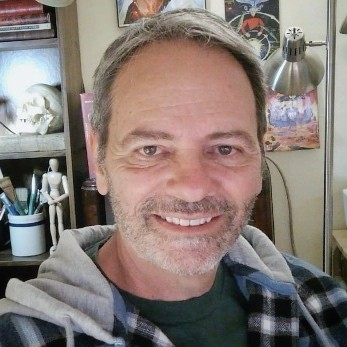
Sam W. Pisciotta is a writer and visual artist. Find his short fiction in Cosmic Horror Monthly, Lightspeed, Asimov’s, Nightmare, PodCastle, and other publications. He is a graduate of the Odyssey writing program (2023) and a member of Clarion’s 2026 Novel Writing Workshop. He has an M.A. in Literary Studies from the University of Colorado. Powered on morning coffee and late-night tea, Sam splits his time between Colorado and New York. Connect at www.silo34.comand @silo34 on Instagram, and @swpisciotta on Bluesky Social.
*~*~*